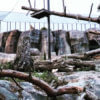
In the spring of 2018 we built rockwork to hide a service wall in Helsinki Zoo’s new Eurasian Lynx Habitat.


In the spring of 2018 we built rockwork to hide a service wall in Helsinki Zoo’s new Eurasian Lynx Habitat.

Main Contractor: Aquarium Technology LTD
Theming contractor: Koda Creative
We were thrilled to be asked by ATL to provide the artificial rock habitat for Macduff Marine Aquarium’s recent kelp tank refurbish. This aquarium is quite remarkable as it is open topped to allow the sun to stream in and enable local kelp species to grow naturally. Koda Creative is always excited to develop habitats which include natural looking geology alongside real flora. This is the first time we have worked in a live kelp setting!
The project started with ATL and MMA staff demolishing the old theming and removing the existing waterproof layer from the aquarium. ATL then applied a new waterproof membrane and resealed the acrylic viewing windows.
Koda Creative, with the input from MMA staff then designed a rock arch similar to a real one on the nearby coastline. It was important that the new rock resembled the local geology as only local species are to be displayed here.
The armature of the new rock arch and other rock elements was then constructed out of inert plastics before being coated with marine grade sprayed concrete. As usual, the concrete was carved and textured like our reference photographs and pigmented further to match the local rock.
The filtration plumbing and life support systems (LSS) are hidden within the artificial rock. The small ‘loose’ stones you see on some of the ledges have the purpose of anchoring the holdfasts of the introduced kelp.


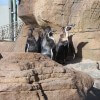
Koda Creative were asked to build the artificial rock for this Humboldt Penguin habitat at Scheveningen Sealife Centre, Holland. We made 165 m2 of rock inspired by the Chilean/Peruvian coastline from where this species originates.
Architect on this project was MDM Advies
Designer of decoration/theming and project manager was Ton Van Helden


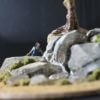
I am working on the habitat design for a new kea Nestor notabilis exhibit. Here is the first draft model of one of the areas.
In the model, the zoo keeper is about to hide some food treats into that tree. The tree is a replica of a wind blown specimen which you might find high up in New Zealand’s South Island Alps. It will be made from steel and shotcrete and have epoxy lined holes into which the treats can be inserted. I have just realised the zoo keeper may have a few problems getting up there so we may have to add some steps into that fake rock or put a stainless steel ladder there.
Also in this habitat, there is a stream, waterfall and pool so the keas can bathe, cool off and wash their food in. The water will be on a closed system kept clean by mechanical, bio and U.V. filtration.
Find out more about keas here via the Kea Conservation Trust of New Zealand


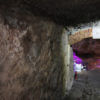
St Michaels Caves are a system of caverns in the Rock of Gibraltar. During recent alterations to public access, the entrance had to be enlarged. This left some ugly strengthening concrete on view. Koda Creative beautified this structural concrete by covering it in our simulated rock.

We matched the outside rock to the inside rock seamlessly and aged and coloured it so that it was indistinguishable from the existing limestone.
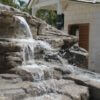
These are some pictures from a recent artificial rock project at a private home in The West Indies.
The steel and concrete rock structure is built around a plant room which houses the water pumps and filtration for the pool. The services are not connected yet so we did a trial run with a submersible pump to test each part of the waterfall. The rocks and waterfall are part of a koi pool set in the landscaped gardens of a beautiful home. The rock has built in irrigated planters. Unfortunately we had to leave before we saw the finished planting and the waterfall at full effect.


Gundis, sometimes known as comb rats, are small rodents which are native to North Africa. They are unusual in the fact that they don’t drink water. They get all their moisture from their food. They also like to chew stones so we a had to make a very strong mix for the artificial rock here.
We made an EPS armature (shape) and coated it with a very hard fine concrete mix. On top of this there is a finer ‘carve’ render which is given the rock texture and coloured. We also built in recesses for heat lamps. Electric conduit tubes were built within the rock so the electrician could easily connect later.
Scroll to bottom of page to see Helsinki Zoo video of Gundis in action
Thanks to zoo keeper Alina Kallio for the animal photos. Check out Alina’s and Timo’s blog here Frog Trail.


The image below is a photo of a small waterfall we made in an amazon themed aviary. The trees to the left are 7m high supports for the stainless steel mesh structure and inspired by buttress trees Ceiba pentandra. The buttress trees and rockwork are made from steel, concrete and shotcrete. The brief for this project was to imagine what a small Amazon Rain Forest tributary waterfall might look like.

To make this artificial environment, we searched on Flickr for ‘amazon waterfalls’ and the following images are amongst what we used for artistic reference. I wanted to post these pictures to show part of the process we use when researching a zoo enclosure project. I hope you think we faithfully reproduced our little imaginary part of the Amazon Rain Forest.
To recap, the image above is fake and the ones below are real.


These are a series of photos showing our progress building an Asian influenced macaque temple exhibit. All pictures shot from roughly the same angle.


Quite often we have to make architectural style rockwork with a temple ruins, Indiana Jones or Tomb Raider theme. The following 20 images were compiled whilst researching such a project. I have left out the obvious head carvings in this round-up, this compilation is all about mysterious entrances, spooky passageways and wondering what is around the next corner.
There are plenty of images from Cambodia here and some others from India, Egypt and Indonesia. Clicking on an image takes you to its Flickr page and there you can find more information about the picture and its photographer.