Humboldt Penguin Habitat Scheveningen Sealife Centre


Koda Creative were asked to build the artificial rock for this Humboldt Penguin habitat at Scheveningen Sealife Centre, Holland. We made 165 m2 of rock inspired by the Chilean/Peruvian coastline from where this species originates.

Architect on this project was MDM Advies
Designer of decoration/theming and project manager was Ton Van Helden

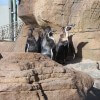
Penguins look at their new habitat.
The penguins cast their eyes over their new habitat.
Nest boxes disguised as caves in the rock.
Nesting burrows built into artificial rock.
Penguin's eye view of habitat.
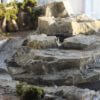
Birds eye view of the Chilean coastline inspired habitat.
Birds eye view.
Planting list included this rosmarinus.
Penguin come on to dry land.
Back to dry land.
Three penguins.
Shake off!
Group of penguins in artificial habitat.
Waterfall.
words
A popular spot. Mixture of sand and rock.
words
Some interesting vantage points for the public. Come face to face with the penguins!

Penguins and artificial rock.


A penguin comes on to dry land.
Slope and steps carved into the artificial rock at strategic points.

Penguins in artificial habitat.


Group of penguins next to their pool.

Penguins at edge of pool.

View of penguin habitat
Opening day. Photo by Sven Molkenboer

Humboldt penguin habitat model


Here are a few shots of our concept model for a Humboldt penguin enclosure. Working closely with Paradise Park, this is a re-design of their existing area which although worked well, needed a more natural looking feel. We built this model after researching the natural habitat and breeding areas of these birds.

Work has already started on the actual enclosure so I will put on more pictures as the project develops.

humboldt-penguin-habitat1

humboldt-penguin-habitat2

humboldt-penguin-habitat3

humboldt-penguin-habitat4

humboldt-penguin-habitat5

Concept model of penguin habitat

Kea habitat designs #1


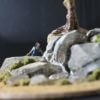
I am working on the habitat design for a new kea Nestor notabilis exhibit. Here is the first draft model of one of the areas.

In the model, the zoo keeper is about to hide some food treats into that tree. The tree is a replica of a wind blown specimen which you might find high up in New Zealand’s South Island Alps. It will be made from steel and shotcrete and have epoxy lined holes into which the treats can be inserted. I have just realised the zoo keeper may have a few problems getting up there so we may have to add some steps into that fake rock or put a stainless steel ladder there.

Also in this habitat, there is a stream, waterfall and pool so the keas can bathe, cool off and wash their food in. The water will be on a closed system kept clean by mechanical, bio and U.V. filtration.

Find out more about keas here via the Kea Conservation Trust of New Zealand
Model of zoo habitat for keaModel of zoo habitat for keaModel of zoo habitatModel of zoo habitatModel of zoo habitat

St Michaels Cave entrance – Faking it!


St Michaels Caves are a system of caverns in the Rock of Gibraltar. During recent alterations to public access, the entrance had to be enlarged. This left some ugly strengthening concrete on view. Koda Creative beautified this structural concrete by covering it in our simulated rock.

st-michaels-cave-gibraltar
Hand carved shotcrete rockwork matching the real rock.

We matched the outside rock to the inside rock seamlessly and aged and coloured it so that it was indistinguishable from the existing limestone.

Rockwork and waterfall for West Indies koi pool

These are some pictures from a recent artificial rock project at a private home in The West Indies.

The steel and concrete rock structure is built around a plant room which houses the water pumps and filtration for the pool. The services are not connected yet so we did a trial run with a submersible pump to test each part of the waterfall. The rocks and waterfall are part of a koi pool set in the landscaped gardens of a beautiful home. The rock has built in irrigated planters. Unfortunately we had to leave before we saw the finished planting and the waterfall at full effect.

artificial rock pool

artificial rock pool

artificial rock pool

artificial rock pool

artificial rock pool

artificial rock pool

artificial rock pool

artificial rock pool


Beautiful geology at Canal Rocks, Western Australia

We are always looking for strange or amazingly beautiful rock formations on our travels and we were not disappointed with this find. Following a tip off from a friend, we drove our rental car north from Margaret River, Western Australia and turned up at Canal Rocks near Yallingup. Here we found a very interesting granite formation with some out of the ordinary features. Canal Rocks has very unusual fault and strata lines and intense colours giving it an almost human made appearance in places. Also some areas of very attractive wind erosion (scroll down to detailed pictures) makes this lump of rock a must see on the Western Australia geological trail.

Canal Rocks is in the Leeuwin-Naturaliste National Park, about three hours drive south from Perth. Aboriginal name for Canal Rocks is Winjee Sam.

canal-rocks-WA-1 canal-rocks-WA-2 canal-rocks-WA-3 canal-rocks-WA-4 canal-rocks-WA-5 canal-rocks-WA-6 canal-rocks-WA-7 canal-rocks-WA-8 canal-rocks-WA-9 canal-rocks-WA-10 canal-rocks-WA-11 canal-rocks-WA-13 canal-rocks-WA

Rock for gundi exhibit

Gundis, sometimes known as comb rats, are small rodents which are native to North Africa. They are unusual in the fact that they don’t drink water. They get all their moisture from their food. They also like to chew stones so we a had to make a very strong mix for the artificial rock here.

We made an EPS armature (shape) and coated it with a very hard fine concrete mix. On top of this there is a finer ‘carve’ render which is given the rock texture and coloured. We also built in recesses for heat lamps. Electric conduit tubes were built within the rock so the electrician could easily connect later.

Scroll to bottom of page to see Helsinki Zoo video of Gundis in action

Thanks to zoo keeper Alina Kallio for the animal photos. Check out Alina’s and Timo’s blog here Frog Trail.

artificial rock for gundis

artificial rock for gundis

gundis in box
Photo Alina Kallio
gundis in box
Photo Alina Kallio
gundis in box
Photo Alina Kallio
gundi
Photo Alina Kallio

Amazon waterfalls

The image below is a photo of a small waterfall we made in an amazon themed aviary. The trees to the left are 7m high supports for the stainless steel mesh structure and inspired by buttress trees Ceiba pentandra. The buttress trees and rockwork are made from steel, concrete and shotcrete. The brief for this project was to imagine what a small Amazon Rain Forest tributary waterfall might look like.

Artificial waterfall in amazon aviary
Amazon aviary waterfall

To make this artificial environment, we searched on Flickr for ‘amazon waterfalls’ and the following images are amongst what we used for artistic reference. I wanted to post these pictures to show part of the process we use when researching a zoo enclosure project. I hope you think we faithfully reproduced our little imaginary part of the Amazon Rain Forest.

To recap, the image above is fake and the ones below are real.
Maruaga waterfalls

Waterfall

Waterfall, Amazon

Light Falls

Amazon landscape waterfall_rs0188

Amazon

Waterfall!

Waterfall, El Yunque, Puerto Rico

Waterfall

Hamadryade Lodge, Amazon Jungle lodge, Ecuador - Activities, waterfalls 9

El Gato Waterfall 4

the Amazon

Holed Stone waterfall

Starved Rock Waterfall

Small waterfall in Jaú National Park

White Faced Sakis enjoy their new trees

We were very happy to see the white faced sakis, golden lion tamarins and pygmy marmosets using the trees we had made a few months previously. It was also good to hear that the enclosure is working as it should and now needs less keeper maintenance.

I managed to take these pictures on a sunny Sunday afternoon when we were taking a break from building the sloth tree. The weather had been so nice in Finland during this visit that the animals were spending a lot of the time enjoying the outdoor part of their enclosure. I got lucky with these ones.

I wrote about the building of these trees in a previous post.

Helsinki zoo made a small video of the animals during their first explorations (scroll to bottom of page to see this)


male white faced saki
Male white faced saki
Female white faced saki
Females
Golden lion tamarin
Golden lion tamarin moving up in the world


Artificial Tree and vines for Coco

Koda Creative often build artificial trees into zoo exhibits. They usually serve some practical purpose for instance, structural supports, places to hide or to provide enrichment possibilities. Trees are generally built from steel and fine concrete. The finish is hand carved and painted appropriately with a suitable non toxic paint.

This artificial rainforest tree was built into an existing zoo enclosure for a Hoffman’s sloth, agoutis and toucans. The tree supports semi-flexible vines which lead to feeding stations and latrine for Coco the sloth. The vines were made to exactly the right diameter for Coco’s claws to help her move around the high enclosure more easily.

Materials used:
Steel, fine concrete, our own recipe epoxy and exterior grade acrylic paint.

For other examples of our trees see:

Two Jungle trees for white face sakis

Amazon aviary


Artificial tree for sloth exhibitArtificial tree for sloth exhibitArtificial tree for sloth exhibitArtificial tree for sloth exhibit

artificial tree in zoo exhibit